
India retains the tag of the fastest growing country among the world's major emerging economies

International Monetary Fund Chief Economist Gita Gopinath tells Indivjal Dhasmana high-frequency indicators for the third quarter of 2021 indicate momentum in economic recovery in India.

Uncertainties on account of COVID-19 pandemic have increased the demand for currency notes not only in India but across the globe, official sources said, dismissing the criticism that demonetisation has failed to reduce cash in the economy. Government sources said that growth of the digital payments system post-demonetisation will ultimately curb the dependence on cash. Official data points out a jump in digital payments through different modes, including plastic cards, net banking and Unified Payments Interface (UPI).
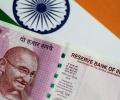
India's current account swung to a deficit for the first time in the current fiscal, with the gap coming at $1.7 billion or 0.2 per cent of the GDP in the December quarter. In the current fiscal, as the pandemic impacted trade, the current account had been in surplus in the previous two quarters, at $15.1 billion and $19 billion, respectively, as per the data on balance of payments released by the RBI on Wednesday. The critical measure of a country's external strength now stands at a surplus of 1.7 per cent of GDP for the first nine months of the fiscal year as against a deficit of 1.2 per cent in the year-ago period. In the December quarter, there was a rise in the merchandise trade deficit to $34.5 billion from $14.8 billion in the preceding quarter, and an increase in net investment income payments.

India's services sector activity expanded at the second-fastest pace in more than a decade during November, driven by sustained rise in new work and improvement in market conditions, a monthly survey said on Friday. The seasonally adjusted India Services Business Activity Index was at 58.1 in November, fractionally down from 58.4 in October. The November figure points to the second-fastest rise in output since July 2011. For the fourth straight month, the services sector witnessed an expansion in output.

Finance Minister Nirmala Sitharaman on Thursday announced a new job creation scheme by giving subsidy to those establishments that make new hires. The subsidy would be to cover for retirement fund contributions by employees as well as employers for two years, she said. Employees contribution (12 per cent of wages) and employer's contribution (12 per cent of wages) totalling 24 per cent of wages would be given to establishments for two years, she said. Under the Aatmanirbhar Bharat Rozgar Yojana, every Employees' Provident Fund Organisation (EPFO)-registered establishment taking new employees would get this subsidy.

China's economy, which suffered 6.8 per cent slump in the first quarter due to the coronavirus pandemic -- the worst in 44 years -- bounced back posting 4.9 per cent growth between July and September buoyed by the government's sweeping efforts to stimulate demand and consumption.

When he didn't respond (Mr Saver has lost count of how many relationship managers he has had in the past few years!), the gentleman landed up at his doorstep and started pleading with him to open fixed deposits with the bank, observes Tamal Bandyopadhyay.

The government should have mentioned clearly the specific structural reforms that were responsible for the deviation from the fiscal deficit target by half a percentage point, says A K Bhattacharya.

The economic costs now beginning to show up in the hard numbers are far worse than initial expectations.

The greatest disconnect lies in the estimates of industrial growth.

The Asian Development Bank on Wednesday revised down India's economic growth forecast for the current fiscal to 10 per cent, from 11 per cent predicted earlier, citing the adverse impact of the second wave of the pandemic. The growth forecast for India in fiscal year 2021 (ending in March 2022) was revised down, as the spike in COVID-19 cases during May dented the recovery, the Asian Development Bank (ADB) said in its latest economic outlook. "The outbreak, however, dissipated faster than anticipated, resulting in several states easing lockdown measures and returning to more normal travel patterns.

The Indian economy requires a Rs 3 lakh crore fiscal stimulus, including cash transfer to households through Jan Dhan accounts to spur economic growth amid the pandemic, industry chamber CII said on Thursday and pitched for appointment of a 'Vaccine Czar' for speedy vaccination coverage. CII president T V Narendran also said the chamber expects GDP to grow at 9.5 per cent in 2021-22 as the strong growth in the second half of the fiscal year will be supported by robust external demand and large-scale coverage of vaccination, allowing resumption of economic activity. He also advocated for appointment of a "Vaccine Czar" for speedy vaccination coverage.

India's GDP is estimated to contract by a record 7.7 per cent during 2020-21 as the COVID-19 pandemic severely hit the key manufacturing and services segments, as per government projections released on Thursday. Amid overall decline in economic activities, some respite was provided by the agriculture sector and utility services like power and gas supply, which have been projected to post positive growth during the current fiscal ending March 2021.
With the world's worst outbreak of COVID pandemic stalling a nascent economic recovery, the government has begun assessing the impact of the second wave of infections on different sectors and may look at providing support at an appropriate time to segments requiring fiscal help. Some of the economic indicators, including the Goods and Services Tax (GST) collections, still provide confidence and incoming data will throw some more light on the state of the economy, sources said. Services sectors like hospitality, tourism and aviation which had just started recovering were hit hard by the second wave of COVID, the sources said, adding these segments might need some support on an urgent basis from the government.

The Reserve Bank has projected the economy to grow by 8-8.5 per cent in 2008-09. Inflation will be brought under 5.5 per cent, RBI said.

The proposal may provide relief to the tune of Rs 9,000 crore to service providers.

A series of steps taken by the government to promote ease of doing business and liberalisation of foreign direct investment norms have helped India receive record FDI inflows so far this year, and implementation of measures like PM Gati Shakti, single window clearance and GIS-mapped land bank are expected to further push investments in 2022. Notwithstanding the global slowdown and the COVID-19 pandemic, total foreign direct investments into India rose to a record $81.72 billion in 2020-21. During April-July this fiscal, FDI (foreign direct investment) into the country increased by 62 per cent to $27.37 billion.

Facing the twin task of fighting the coronavirus pandemic today and building a better tomorrow, the world is experiencing a new Bretton Woods moment, IMF managing director Kristalina Georgieva said
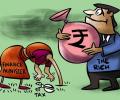
While the tax-to-GDP ratio of 9.88 per cent has been assumed for FY21, the same as last year, when it touched a decadal low, for FY22 a ratio of 10.7 per cent has been assumed, an average of the last five years.

In the midst of third wave of COVID-19, Finance Minister Nirmala Sitharaman has come up with an impactful Budget which is balanced, fiscally prudent and growth-oriented, the USA India Chamber of Commerce has said. President of the Boston-based USA India Chamber of Commerce (USAIC) Karun Rishi, however, said it is a matter of concern that the budget lacks tangible measures to increase revenue generation. "Opting to keep the fiscal deficit at 6.9 per cent and increase capital expenditure by 35 per cent is a masterstroke. "The annual budget estimates the effective capital expenditure of Rs 10.68 lakh crore in 2022-23, making up about 4.1 per cent of the GDP," he said. "A phenomenal increase in the government's capital expenditure is likely to facilitate the expenditures on infrastructure and create jobs.

Dr Ajay Kumar Sood will have to complete a task his predecessor started: Getting the government to sign off on a new Science, Technology, and Innovation Policy on which work was begun in 2020.
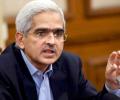
The rising COVID-19 infections across the country are a matter of concern, but it may not impact the ongoing economic revival as one does not foresee lockdowns, Reserve Bank Governor Shaktikanta Das said on Thursday. The economic revival will continue "unabated", Das said, asserting that there is no need for a downward revision of RBI's 10.5 per cent GDP growth forecast for FY22. Speaking at Times Network's India Economic Conclave, Das said, "We have 'insurance' to protect economic revival like a fast-paced vaccination drive, greater ability among people to follow COVID protocols", and one does not see lockdowns as well.

Of the Rs 20-lakh-crore package that Prime Minister Narendra Modi announced to defend the economy against coronavirus disruptions, fresh support may be only around 60 per cent of the offer as it counts the first financial stimulus and liquidity support that Reserve Bank has given already, and will overburden the bond market, says a report.

We will find it difficult to exceed an average of 5 per cent growth in the medium term, warns Shankar Acharya, the former chief economic adviser.
CSO revised downwards the construction sector numbers, which account for nearly 9 per cent of India's GDP, for the fourth quarter of fiscal 2008. This revision to 6.9 per cent as against the initial estimate of 12.6 per cent leads to 40 basis point upside to GDP growth. For agriculture, CSO revised the growth numbers to 2.2 per cent as against the initial estimate of 3.5 per cent. This led to higher agriculture growth of 2.7 per cent in January-March 2009.

At all India level, per capita income will decline by 5.4 per cent in FY21 to Rs 1.43 lakh, the report said.

Direct economic stimulus measures such as tax cuts for individuals and industry would have helped to prop up the Indian economy which was hit hard by the lockdowns across several states in India, say economists and corporate leaders. While the measures announced on Monday are focussed more on the supply side, these steps would take a lot of time to move the needle for the economy.

Though the NITI Aayog did not give its estimates for the required GDP growth at constant prices, economists pegged it at 9 per cent, a feat not seen since the GDP series was revised with 2011-12 as the base year.

S&P Global Ratings on Thursday said the Indian economy is projected to grow at 11 per cent in the current fiscal, but flagged the "substantial" impact of broader lockdowns on the economy. In its report on Asia-Pacific Financial Institutions, S&P said the control of COVID-19 remains a key risk for the economy. New infections have spiked in recent weeks and the country is in the middle of a second pandemic wave.

The US Federal Reserve on Wednesday (local time) raised interest rates by 75 basis points (bps) or three-quarters of a percentage point in the boldest move since 1994.

From the 30-share basket, 28 scrips suffered losses. Over 200 stocks were at their 52-week low in Tuesday's trade.
Finance Ministry had pegged the growth at 5.7 per cent and RBI at 5.5 per cent.

Upbeat high-frequency indicators and consumer confidence show that Indian economy continues to forge ahead, emerging out of shackles of pandemic, said an article on the state of economy published in RBI Bulletin on Wednesday. The recovery is spearheaded by an uptick in private investment through November-December alongside a turnaround in bank credit offtake and high capex from the government sector (Centre and states). In conjunction, the employment situation has brightened, said the article written by RBI officials.

In twin blows to Indian economic revival, higher food prices drove retail inflation to a five-month high of 7.4 per cent while factory output fell for the first time in 18 months. The second consecutive month of rise in consumer price index (CPI)-based inflation will add to the pressure on the Reserve Bank of India (RBI) to again raise interest rates to tame high prices. Inflation has been above the targeted zone for the ninth month in a row and as per statute, the RBI will now have to explain to the government in writing why it failed to keep prices below 6 per cent.

India's growth in the last three financial years has averaged just 1.9%. It is natural to project rapid growth from this low base. Crucial to that would be the assumption that the economy has suffered no lasting damage from the pandemic, observes T N Ninan.

Asian Development Bank on Wednesday lowered India's economic growth forecast for FY2019 to 5.1 per cent on slowing job prospects, rural distress exacerbated by poor harvest and credit crunch. Growth in FY2020 is likely to recover thanks to this support, low oil prices, and a weakening rupee, but risks to the projections remain tilted to the downside, it said on India.
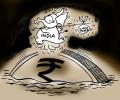
India's public debt ratio, which remarkably remained stable at around 70 per cent of the GDP since 1991, is projected to jump by 17 percentage points to nearly 90 per cent because of increase in public spending due to COVID-19, the IMF said.

Xi does not want to risk any political or economic crisis complicating his bid to remain in office, observes Ambassador Shyam Saran, the former foreign secretary.

Stating that India's economic stimulus was not adequate, Banerjee said, the measures did not increase consumption spending of lower income people as the government was not willing to put money in the hands of the low income population.
 © 2026 Rediff.com - Advertise with us - Disclaimer - Privacy Policy - Sitemap - Feedback - About us - Terms of use - Grievances